
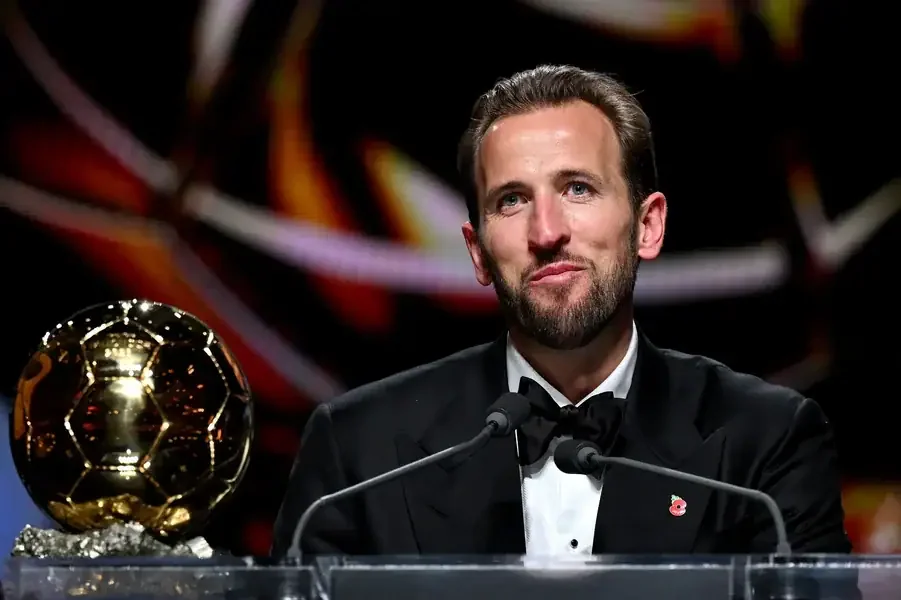
At a news conference on Tuesday, Nov. 11, England manager Thomas Tuchel was asked whether Harry Kane could be considered the greatest player in the history of England. The report says Tuchel answered the question, but it does not include his response. The question followed Kane’s recent Ballon d’Or victory and renewed attention to his accomplishments for both club and country.
Kane was named the world’s best player on Oct. 26, when he won the Ballon d’Or, according to the report. He became only the fifth English player to receive the award and the first since Michael Owen, who won it in 2001. That achievement prompted the question put to Tuchel: whether Kane’s honors and records place him at the top of England’s football history.
The report also identifies Kane as Bayern Munich’s striker and England’s all-time leading scorer, with 91 goals for the national team. It says he was expected to set a new England appearance record when he took the field against Croatia on Thursday, Nov. 12. The article presents those milestones as context for the debate, rather than as a conclusion about how Kane should be ranked among the country’s players.
The question of who is the greatest player in a country’s history involves more than one kind of achievement. A player’s goals for the national team, number of appearances, honors and impact at club level can all be part of the discussion. The report does not set out a particular formula for weighing those measures, and Tuchel’s answer is not reproduced in the supplied text. It therefore records the question and the facts that brought it into focus without providing a full account of the manager’s reasoning.
Kane’s scoring record is specifically a record for England’s national team. The figure of 91 refers to goals scored while representing the country, not to a combined total from club and international matches. Likewise, the appearance record mentioned in the report concerns matches played for England. Keeping those categories separate helps clarify the two national-team milestones associated with Kane: the number of goals he has scored and the number of times he has represented the side.
According to the report, Kane was set to become England’s record-holder for appearances by playing against Croatia. The wording describes a milestone expected from that match; it does not give a final appearance total or provide further details about the game. The distinction matters because the article refers to the record before the match takes place. Its central point is that Kane’s scoring achievement was already established, while the appearance record was expected to be reached when he played on Thursday.
The Ballon d’Or is another measure raised by the story. Kane’s victory made him the fifth English recipient, following Stanley Matthews, Bobby Charlton, Kevin Keegan and Michael Owen. The report lists Matthews as the winner in 1956, Charlton in 1966, Keegan in 1978 and 1979, and Owen in 2001. Keegan won twice, so the list of recipients and the number of awards are not identical: five English players are named, while the years listed include two victories for Keegan.
Those historical names provide a point of comparison, but the article does not claim that winning the Ballon d’Or alone settles the question of who is England’s greatest player. It says Kane’s award brought the question to Tuchel. The award and the national-team records are distinct accomplishments: one is the honor cited in the report, while the other two concern Kane’s goals and appearances for England.
The discussion also distinguishes a player’s standing in England’s football history from his current role. Kane is identified as a Bayern Munich player and as a member of England’s national team. The report links his club identity to his current career, while the statistics it gives—91 goals and the anticipated appearance record—are specifically tied to England. These details describe different parts of his playing record and should not be treated as interchangeable measures.
Tuchel’s position as England manager gives him a direct connection to the question, but the supplied account does not quote him or summarize his specific judgment. It would therefore be inaccurate to attribute a particular ranking, endorsement or qualification to him based on this text alone. What the report establishes is that he was asked whether Kane could be considered the greatest player in England’s history and that Kane’s Ballon d’Or win and national-team records were the context for the question.
The article’s focus is not only on an individual award but also on how Kane’s achievements are being considered alongside those of previous English players. Matthews, Charlton, Keegan and Owen are identified through their Ballon d’Or wins, while Kane is associated with the latest victory described in the report. His national-team scoring record and expected appearance milestone add separate measures to that comparison. The report leaves the broader evaluation open rather than defining a single standard for greatness.